

Birch-Faced vs Full Birch Plywood: What Are You Actually Buying?
Two sheets can have similar birch surfaces and very different internal constructions. That difference matters when a panel is routed, drilled, assembled or supplied against a project specification.
Birch-faced plywood identifies the outer veneer; it does not fully identify the core. Full birch plywood uses birch veneers throughout the face, back and internal layers. To distinguish the products in this comparison, “birch-faced” means birch outer veneers over a declared non-birch or mixed-species core.
For EU project contractors, wholesalers and importers, the decision should follow the finished component’s requirements. A concealed cabinet panel and an exposed-edge display unit do not necessarily need the same construction.
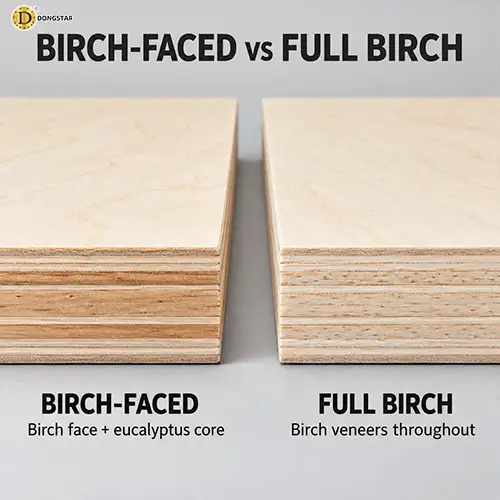
Birch-Faced vs Full Birch: The Purchasing Difference
| Purchasing question | Birch-faced plywood with another core | Full birch plywood |
|---|---|---|
| What is inside? | Declared hardwood, softwood or mixed-species veneers beneath the birch surface | Birch veneers throughout |
| Can the surface look similar? | Yes; outer veneer selection and finishing determine the visible face | Yes; full-birch construction does not itself specify face appearance |
| What happens at cut edges? | Appearance depends on the species, veneer thicknesses and core workmanship | Birch layers remain visible, but gaps, repairs and thickness variation still need checking |
| Can strength be inferred from the name? | No; request data for the specified construction | No; request data for the specified construction |
| What should the quotation identify? | Face/back species and thickness, plus the complete core layup | Birch throughout, ply arrangement and relevant performance data |
Birch-faced plywood is not inherently an inferior product. It is a different specification. The problem arises when a quotation leaves that specification unclear.
When Is Full Birch Plywood Worth Considering?
Exposed-edge furniture and commercial interiors
Consider full birch when the layered edge is part of the design: open shelving, reception counters, retail fixtures or furniture with routed profiles.
Ask for finished-edge samples. Species consistency is only one part of the result; veneer joints, core gaps, sanding and coating also affect appearance.
If a project drawing explicitly requires full birch plywood, a birch-faced alternative changes the specification. Obtain the project team’s approval before substitution.
Components with demanding machining requirements
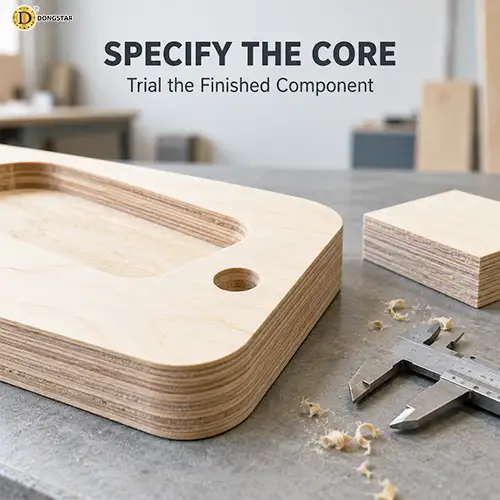
For CNC-cut parts, joints, drilled patterns and routed recesses, assess how the complete panel behaves during production.
Full birch is a candidate to evaluate where these operations are important. However, “full birch” does not guarantee a void-free edge, a particular screw-withdrawal result or a specified machining yield.
Ask the full birch plywood supplier for construction details and relevant product data, then trial the intended component. European manufacturers publish technical information for their particular birch products; those results should not be transferred to a different supplier’s panel.
When Can Birch-Faced Plywood Be the Better Purchase?
Covered edges and concealed construction
Birch-faced hardwood or combi-core plywood is worth evaluating for cabinet carcasses, partitions and interior components where edges are covered and the birch surface provides the required appearance.
Its commercial value depends on meeting the component specification at an acceptable total cost. A lower sheet price alone does not establish that value.
Discuss the available birch plywood constructions for bulk orders and request a proposed layup for the application.
Separate component specifications within one project
A furniture programme can use different approved panels for different parts. Exposed-edge shelving may require full birch, while a covered cabinet component may accept another declared core.
Use separate material codes and cutting instructions. Otherwise, visually similar panels can be mixed during warehousing or assembly.
For distributors offering wholesale birch plywood, product descriptions should identify the construction clearly. “Birch-faced eucalyptus-core plywood” tells customers more than “premium birch plywood.”
Four Differences to Verify Before Comparing Prices
1. Veneer arrangement
Request a layer-by-layer description showing species, veneer thicknesses and grain orientation.
“Hardwood core” and “combi core” leave important details unresolved. Two mixed-species panels may have different layups even when they share a commercial name.
Ply count is useful information, but it is not a standalone quality score.
2. Face veneer thickness
State the finished face veneer thickness and tolerance where sanding, routing or refinishing makes it relevant.
A face-grade label describes appearance under the agreed rules. It does not specify how much material remains above the first glue line. Keep birch plywood face grades separate from the construction schedule.
3. Weight
Do not assume every birch-faced panel is lighter than full birch. Request the density range and sheet weight for each proposed construction at a stated moisture condition.
For planning:
Estimated sheet weight = length × width × thickness × density.
For example, a nominal 1220 × 2440 × 18mm sheet has a volume of approximately 0.0536m³. At an assumed density of 650kg/m³, its estimated weight is 34.8kg.
This is a calculation example, not a declared Dongstarwood product weight. Use confirmed product and packing weights for shipment planning.
4. Bonding and service conditions
Core species does not establish bond durability or suitability for wet conditions.
Request the performance evidence relevant to the intended use, including the test method and exact panel construction covered. Review surface and edge protection separately where moisture exposure is expected.
Avoid treating the words “birch,” “full birch” or “WBP” as a complete application specification.
How to Qualify a Birch-Faced Alternative
When considering a change from full birch to another core, test a production-relevant component rather than judging an uncut sheet.
Agree a comparison using the same drawing, tooling and acceptance criteria:
- Cut and route: inspect the edges, recesses and joints exposed by machining.
- Drill and assemble: trial the actual hardware and fastener positions.
- Finish: evaluate exposed edges and surfaces under the specified coating.
- Check dimensions: measure the component against its finished tolerances.
- Evaluate performance: arrange suitable testing where the application requires it.
Record the approved construction and results. A successful trial of one layup does not qualify every product described as birch-faced plywood.
For repeat container orders, require approval before changes to core species or veneer arrangement.
Compare Cost per Accepted Component
A useful purchasing comparison includes landed panel cost, processing and the number of usable components.
Consider this hypothetical example, with all figures in euros:
| Item | Option A | Option B |
|---|---|---|
| Landed panel cost | €40 | €45 |
| Processing and rework per panel | €12 | €10 |
| Accepted components per panel | 8 | 10 |
| Cost per accepted component | €6.50 | €5.50 |
These figures illustrate a calculation; they do not represent market prices or expected differences between core types.
The more expensive sheet can produce the lower component cost. Equally, if both constructions deliver the same accepted yield, the lower-priced approved panel may be the better purchase.
For a bulk birch plywood order, establish that comparison with trial results.
Questions EU Importers Should Ask the Supplier
Before accepting a birch plywood quotation, confirm:
- Which species are used in the face, back and each internal layer?
- What are the finished veneer thicknesses and panel tolerances?
- Which test reports apply to this exact construction?
- What internal defects are permitted?
- Can representative samples be supplied for machining trials?
- How will the approved construction be identified and controlled across repeat orders?
Also request the documentation appropriate to the destination and intended application. A report for a different thickness, layup or product should not be assumed to cover the proposed order.
FAQs
Not necessarily. Birch-faced describes the outer veneer. Full birch specifies birch veneers throughout. Request the core declaration to distinguish them.
The name alone is insufficient for that comparison. Evaluate the relevant test results, thickness, layup and loading direction for the actual products.
It may be an approved alternative where the finished component meets the required appearance, machining and performance criteria. Obtain approval where full birch is specified.
No universal weight ranking applies. Compare measured or declared density and sheet weights for the proposed panels under comparable conditions.
An edge photograph can reveal visible construction features, but colour alone is unreliable for confirming species. Request a written layup declaration and appropriate verification where needed.
Request a Construction-Specific Bulk Quote
Dongstarwood’s birch plywood range lists full-birch and alternative core options. Availability should be confirmed against the requested construction and order.
Send your component application, edge finish, dimensions, quantity and destination port. State whether full birch is mandatory or an alternative core may be evaluated.
Request a birch plywood construction comparison and bulk quotation with the specification needed for a meaningful purchasing decision.
Related Articles
- All Posts
- Company News
- Product Post
Birch-Faced vs Full Birch Plywood: What Are You Actually Buying? Two sheets can have similar...
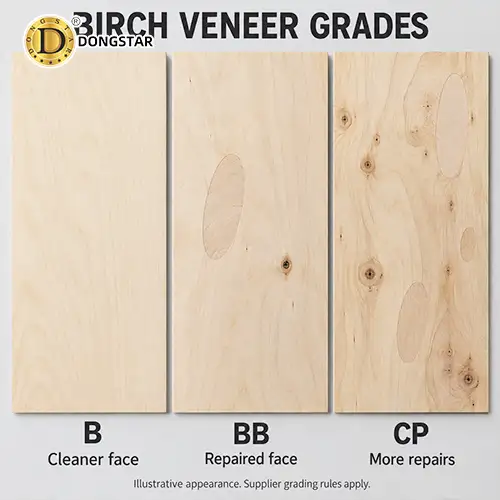
Birch Plywood Grades: B/BB vs BB/BB vs BB/CP for EU Buyers Birch plywood grades such...
For European plywood importers, furniture manufacturers, wholesalers and project contractors, choosing a supplier is about...
For European furniture manufacturers, wholesalers, importers and project contractors, Vietnam Birch Plywood has become an...
The global plywood market is changing. European construction companies, furniture manufacturers, distributors, and wholesalers are...
For European importers, wholesalers, furniture manufacturers, and construction companies, choosing the right plywood is no...