

Choose poplar-core plywood when reducing panel weight is a priority and the specified panel meets the component’s performance requirements. Consider full-birch plywood when stiffness, machining or exposed edges are central to the design. When comparing poplar-faced and birch-faced panels, establish the core construction before drawing either conclusion.
For EU importers, wholesalers and interior contractors, the aim is to match material to the finished component. Specifying the same plywood throughout a furniture programme can mean paying for properties that some parts do not need.
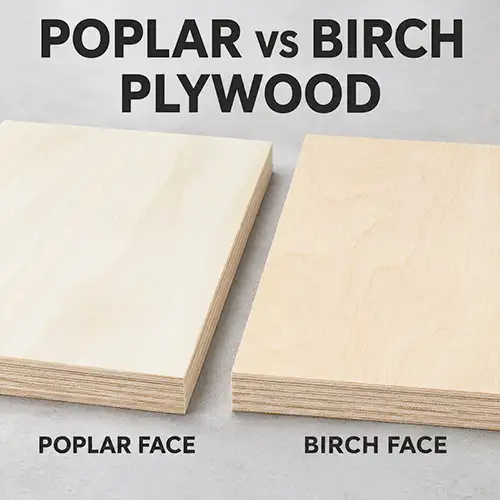
First, Establish What “Poplar” and “Birch” Describe
A plywood name may identify its face veneer, its core or both.
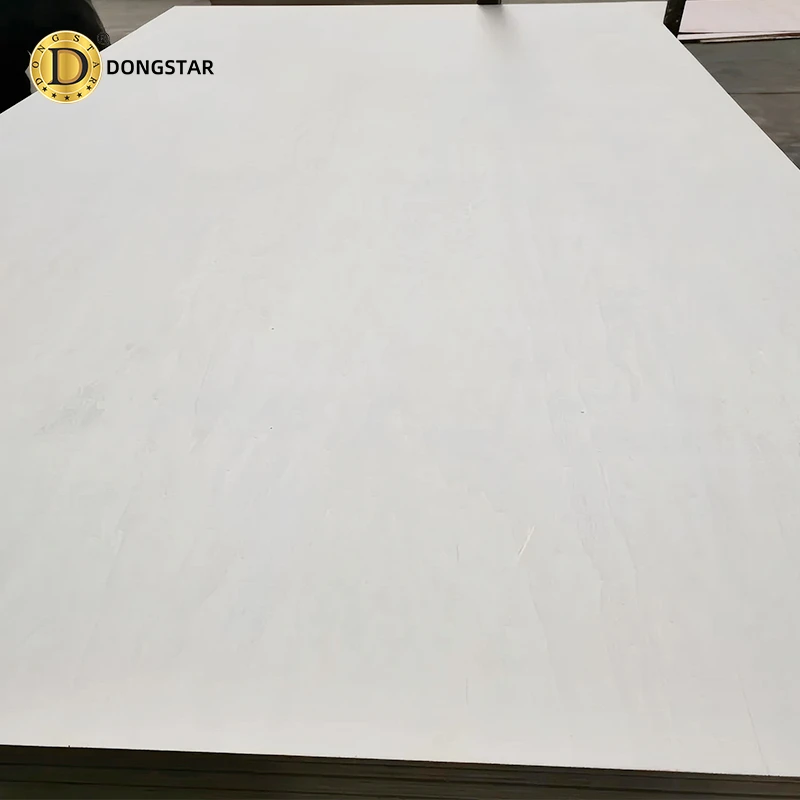
Dongstarwood’s bleached poplar-faced plywood uses a lightened outer veneer over a specified core. Its birch plywood range also includes different internal constructions.
Three comparisons therefore need separate treatment:
| Comparison | What you are evaluating |
|---|---|
| Poplar throughout vs birch throughout | Different species across the panel, with performance also affected by layup and manufacturing |
| Poplar face vs birch face over the same core | Primarily surface appearance and finishing; core-related differences may be much smaller |
| Poplar-faced mixed core vs birch-faced mixed core | Two complete specifications that require their own weight and performance data |
A bleached poplar face is a surface specification, not a guarantee of a lightweight panel. Bleaching does not identify the internal species or establish panel strength.
Poplar vs Birch Plywood: A Practical Selection Guide
The following are starting points for evaluation, not guaranteed properties of every panel sold under these names.
| Purchasing priority | Starting point | What must be checked |
|---|---|---|
| Lower component weight | A declared lightweight poplar-core construction | Actual density, finished panel thickness and required performance |
| Stiffness within a fixed thickness | A suitable full-birch construction, compared with alternatives | Relevant stiffness data, grain direction, support spacing and service conditions |
| Pale substrate for painted furniture | Bleached poplar-faced plywood | Coating compatibility, surface repairs and finished appearance |
| Visible natural birch grain | Birch-faced plywood | Approved face appearance and finishing sample |
| Decorative layered edges | Full birch or an approved decorative mixed-core panel | Machined edge appearance, internal defects and finishing |
| Lowest total project cost | Either approved construction | Purchase price, processing, finishing, handling and installation |
Weight: How Much Difference Reaches the Finished Product?
Published manufacturer data shows why construction matters. Garnica’s all-poplar Efficiency panel lists a density of 420–480kg/m³. Its poplar-faced, eucalyptus-reinforced panel lists 630kg/m³ at 12mm thickness. These are product-specific examples, not Dongstarwood specifications or universal poplar values.
For your order, request weights for the exact panels being quoted, with moisture conditions stated.
Consider an illustrative 600 × 800 × 18mm component:
| Assumed panel density | Calculated component weight |
|---|---|
| 450kg/m³ | Approximately 3.9kg |
| 680kg/m³ | Approximately 5.9kg |
The difference is approximately 2kg per component, before finishes and hardware. Across 1,000 components, that approaches two tonnes.
These assumptions demonstrate the calculation only; they do not classify the two products in your quotation.
Also distinguish weight reduction from freight savings. A lighter load does not necessarily reduce a container’s booking price. Benefits depend on whether the shipment is limited by payload, volume or another constraint.
Strength: Compare the Shelf or Joint, Not Just the Species
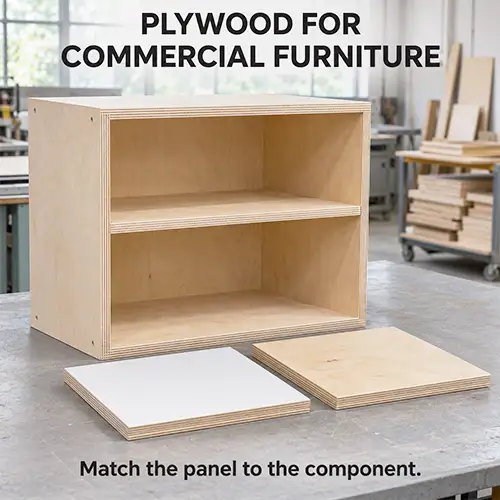
For plywood for commercial furniture, strength and stiffness should be considered separately. A shelf may remain intact yet deflect more than the project permits.
Before substituting poplar for birch, define:
- Unsupported span and support arrangement.
- Expected loading and duration.
- Allowable deflection.
- Panel thickness and grain orientation.
- Joint and fixing requirements.
Then compare appropriate product data or test the finished assembly.
Do not compensate for a change in material by adding thickness without reviewing the consequences. Thicker panels can alter hardware positions, cutting yield, packaging and the original weight advantage.
A birch face over another core should not be assigned the performance of a tested all-birch panel.
Finishing: Is the Surface Being Painted or Left Visible?
Painted and covered furniture
Bleached poplar-faced plywood is worth evaluating when a light-coloured substrate suits the finish. Specify permitted colour variation, repairs and surface preparation.
Compare a completed coating trial rather than the bare veneer alone. Record primer and topcoat use, sanding, drying and any rework. A pale face does not automatically eliminate preparation.
For opaque laminates, assess the substrate’s flatness, surface soundness and bonding compatibility; the visible wood colour may be less important.
Clear-finished joinery
Birch-faced plywood is a logical candidate when the design calls for natural birch grain. Approve the face and its finish together, especially where adjacent panels must look coordinated.
If edges remain exposed, review them separately. The desired surface appearance does not determine which core will produce an acceptable finished edge.
Machining and Hardware: Where a Cheaper Panel Can Become Expensive
Both poplar-based and birch-based products can be machined for furniture. The relevant question is how the specified panel performs with your tooling and component design.
For CNC production, compare edge breakout, recess quality and the condition of narrow sections. For cabinet hardware, assess the actual fastening arrangement, including fixing position, pilot holes and repeated assembly where relevant.
Avoid specifying screw-holding performance from the face species alone. Fasteners may engage several layers, and face and edge fixings impose different demands.
Which Panel Fits Common Commercial Applications?
| Application | Procurement approach |
|---|---|
| Lightweight cabinets and modular interiors | Evaluate a declared low-density poplar-core panel, with hardware and assembly requirements confirmed |
| Painted cabinet panels and wardrobe components | Compare bleached poplar and birch faces over suitable cores using the complete finishing process |
| Exposed-edge reception desks and retail fixtures | Evaluate full birch and approved alternatives against a finished visual reference |
| Shelving with demanding span or load requirements | Select using relevant stiffness data and component design; do not approve by species name alone |
| Decorative wall panels | Prioritise finish, flatness, fixing method and project requirements; consider weight where installation benefits |
| Distributor stock programmes | Separate lightweight-core products, decorative face options and full-birch products in stock descriptions |
A project can use more than one construction. Keep approved materials tied to component codes so visually similar panels are not mixed.
Compare Bulk Prices on the Same Basis
There is no reliable fixed percentage by which poplar plywood is always cheaper than birch.
For a wholesale plywood quotation, align the dimensions, thickness tolerances, face requirements, core, bonding performance, order volume and delivery terms first.
Also check the pricing unit. A price per cubic metre cannot be compared directly with a price per sheet. Use the actual quoted dimensions and thickness, then account for the cutting layout.
Before placing a bulk furniture plywood order, consider costs beyond the panel:
- Additional supports or hardware required by the selected construction.
- Finishing materials and labour.
- Cutting waste and handling damage.
- Packaging and transport constraints.
- Installation requirements.
A lower panel price is useful when the finished component still meets the agreed specification.
What Should an EU Importer Put in the Enquiry?
Give the supplier enough information to propose a suitable construction:
| Requirement | Information to provide |
|---|---|
| Component | Application, drawing and visible surfaces |
| Material | Face/back species and required or acceptable core |
| Weight | Maximum panel or component weight, where relevant |
| Performance | Load, fixing, machining and service requirements |
| Finish | Paint, clear coat, laminate or exposed veneer |
| Supply | Dimensions, tolerances, quantity, delivery terms and destination |
Request relevant product documentation, representative samples and written confirmation of the construction being quoted. Documentation must apply to the proposed product, not simply another panel from the same manufacturer.
FAQs
All-poplar plywood is often lighter than full-birch plywood of the same size and thickness. Poplar-faced plywood with a denser core may not offer that advantage. Compare the actual panel weights.
Bleaching concerns surface appearance. It is not evidence of increased structural capacity, improved bonding or a lighter core.
It can be evaluated for suitable components, provided the approved construction meets the required stiffness, hardware, finish and service conditions. A project-specified material change needs approval.
Either can work with a suitable surface and coating system. Compare finished samples and processing requirements rather than assuming one species always needs less preparation.
No. Confirm the specified panel’s suitability for the environment, including bonding, finishes, edge protection and installation. The face species alone is insufficient.
Compare Poplar and Birch Options for Your Next Order
Dongstarwood supplies bleached poplar-faced and birch plywood with specified core options for furniture and interior buyers.
Send your application, finish, dimensions, weight target, quantity and destination port. State whether an alternative construction may be considered.
Request a poplar and birch plywood specification comparison before confirming your bulk order.
Related Articles
- All Posts
- Company News
- Product Post
Compare poplar and birch plywood by core, weight, machining and finish to specify the right...
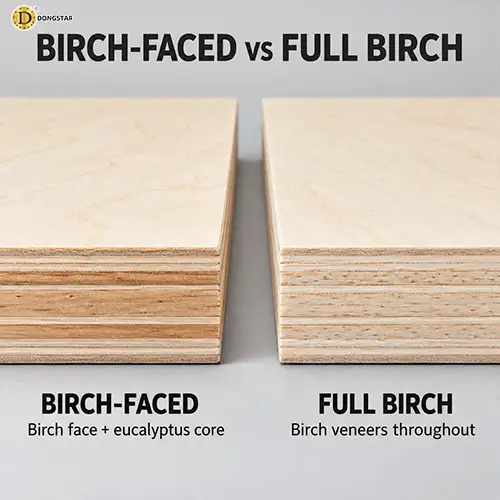
Birch-Faced vs Full Birch Plywood: What Are You Actually Buying? Two sheets can have similar...
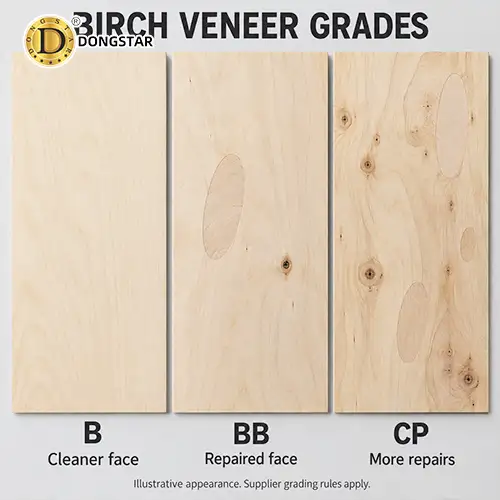
Birch Plywood Grades: B/BB vs BB/BB vs BB/CP for EU Buyers Birch plywood grades such...
Introduction: Why This Comparison Matters in 2026 If you are sourcing plywood for European projects...

If you’re a Plywood Importer in Europe, 2026 feels different. Supply chains have shifted, regulations...
Whether you’re building shelving, cabinets, renovation accents, or custom furniture, birch plywood often tops the...