

If you’re sourcing materials for construction, furniture, or large-scale projects in Europe, you’ve probably noticed something changing fast—Vietnam Plywood is gaining serious traction, while China wood is facing growing resistance.
This isn’t just a trend. It’s driven by EU regulations, cost pressure, and supply chain risk. Over the past two years, European buyers have actively shifted sourcing strategies, and plywood is right at the center of that shift.
So the real question is:
For EU projects in 2026, which is actually better—Vietnam Plywood or China wood?
Let’s break it down the way real buyers think: cost, compliance, reliability, and long-term risk.
1. EU Market Shift: Why Buyers Are Moving Away from China Wood
The European plywood market has changed dramatically since 2024.
- The EU imposed anti-dumping duties up to 62.4%–86.8% on Chinese plywood
- Demand for China wood has stagnated due to trade restrictions and compliance concerns
- At the same time, Vietnam exports to Europe are rising fast, especially for project supply
In simple terms:
China wood is no longer the default choice for EU buyers.
Instead, buyers are asking:
- Can this product pass EUDR?
- Is the supply chain traceable?
- Will customs clearance be smooth?
That’s where Vietnam Plywood starts to stand out.
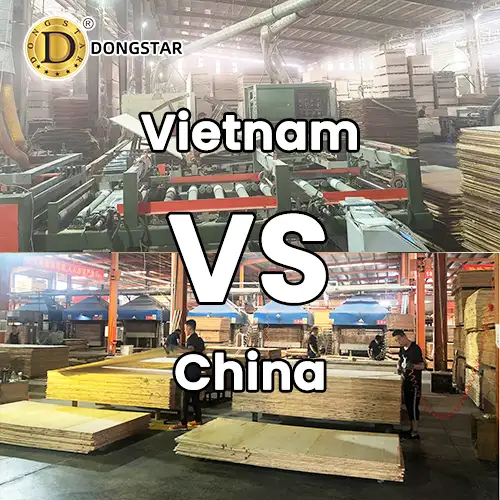
2. Price Comparison: Vietnam Plywood vs China Wood (Real Landed Cost)
At first glance, prices might look similar—but the real cost difference shows up after import.
FOB Price
- Vietnam Plywood: typically 5–12% cheaper than China wood for similar grades
EU Landed Cost
- Vietnam: 0% import duty (EVFTA)
- China: up to 86.8% anti-dumping duty
That means even if China wood looks cheaper on paper,
it often becomes 20–80% more expensive after landing in Europe.
For project buyers working on tight margins, this alone is a deal breaker.
3. Certification & Compliance: The Real Deciding Factor
For EU markets in 2026, compliance is no longer optional.
Vietnam Plywood Advantages
- FSC-certified supply widely available
- EUDR-ready (plantation-based timber)
- CARB P2 emission compliance
- Full traceability from plantation to factory
China Wood Challenges
- Mixed supply chains (often involving imported timber)
- Higher risk of mislabelled certification
- Difficulty proving legality under EUDR
A 2025 industry analysis found that a significant portion of certified Chinese plywood had traceability concerns linked to high-risk timber sources
For EU importers, this translates to:
- Customs delays
- Documentation risk
- Potential shipment rejection
4. Quality Comparison: What Project Buyers Actually Care About
Forget marketing claims—this is what matters on-site.
Vietnam Plywood
- Core materials: Acacia, eucalyptus (hardwood)
- Stronger load-bearing capacity
- Better screw holding
- Consistent thickness and bonding
China Wood
- Often uses poplar or mixed cores
- Quality varies widely by supplier
- Risk of internal gaps or inconsistent layers
For construction or furniture projects,
Vietnam Plywood delivers more predictable performance.
5. Supply Chain Stability: A Hidden but Critical Factor
Here’s something many buyers underestimate.
Vietnam
- Relies on domestic plantation timber
- Stable raw material supply
- Predictable production timelines
China
- Heavily dependent on imported logs (Russia, etc.)
- Vulnerable to sanctions and disruptions
- Price fluctuations more common
Result:
Vietnam offers more stable long-term supply contracts.
6. Lead Time & Logistics
Surprisingly, both countries are quite similar here:
- Vietnam: 15–20 days production
- China: 15–25 days production
But the difference shows in:
- Documentation speed
- Export transparency
- Risk of customs inspection
Vietnam tends to be more predictable for EU shipments.
7. Risk Analysis: What Could Go Wrong?
Let’s talk honestly—because this is what buyers really care about.
China Wood Risks
- Anti-dumping tariffs
- EUDR compliance failure
- Certification disputes
- Supply chain opacity
Vietnam Plywood Risks
- Occasional inconsistency with small factories
- Need to choose certified, export-ready suppliers
But overall:
Vietnam has lower regulatory risk for EU markets.
8. When Should You Still Choose China Wood?
To be fair, China wood still works in some cases:
- Non-EU markets with no tariffs
- Ultra-low-cost, non-certified projects
- Buyers with strong in-house inspection teams
But for EU projects, the disadvantages usually outweigh the savings.
9. When Vietnam Plywood Is the Better Choice
Vietnam Plywood is clearly the better option if you need:
- EU compliance (EUDR, FSC, CE)
- Stable pricing
- Reliable supply chain
- Lower landed cost
- Consistent quality
Which is exactly what most contractors, importers, and developers are looking for today.
10. FAQs: What EU Buyers Are Searching Right Now
1. Is Vietnam Plywood better than China wood for EU markets?
Yes. Due to lower tariffs, better compliance, and stable supply, Vietnam Plywood is generally the better choice for EU imports.
2. Why is China wood becoming less popular in Europe?
Mainly because of anti-dumping duties and stricter environmental regulations.
3. Is Vietnam Plywood cheaper than China wood?
Yes—especially after factoring in EU import duties, Vietnam is significantly more cost-effective.
4. Does Vietnam Plywood meet EUDR requirements?
In most cases, yes. Vietnam uses plantation timber with traceable supply chains.
5. What industries prefer Vietnam Plywood?
Construction, furniture manufacturing, packaging, and infrastructure projects.
6. How do I choose a reliable Vietnam Plywood supplier?
Look for FSC certification, export experience, and transparent documentation.
Conclusion: The Smart Choice for EU Buyers in 2026
If this were 5–10 years ago, China wood might still dominate.
But today?
The equation has changed.
Between tariffs, compliance, and supply chain risk, Vietnam Plywood has become the more practical, safer, and cost-effective choice for EU markets.
For project buyers, it’s no longer just about price—
it’s about certainty.